For years, a wildfire mitigation plan was a good-practice document: a utility wrote down its vegetation program, inspection cycles, and storm protocols, filed the plan if a regulator asked, and got back to work. That era is over across most of the West and a growing share of the plains. In 2025 and 2026, Idaho, Montana, Wyoming, Texas, Arizona, North Dakota, and South Dakota passed laws that tie a utility’s legal position after a fire to the mitigation plan itself, and Kansas raised the bar wildfire plaintiffs must clear.1 Washington now requires commission approval of investor-owned utilities’ plans.2 In several of these states, operating under an approved plan creates a presumption that the utility was not negligent.
The main reader used to be a program manager checking a filing requirement. Now it is commission staff deciding whether the plan deserves approval, insurers pricing the utility’s exposure, and, after a bad day, opposing counsel reading every page for a commitment that was not kept. Regulators are preparing for that role: NARUC’s wildfire workbook, completed in January 2026, walks state commissions through the questions to ask, and the expectation running through it is that mitigation choices come with a quantified risk basis.3 Arizona has already shown how fast scrutiny arrives. The first plans under its new statute were filed in February and March of this year and drew public attacks within weeks: insurers and trial lawyers called them sparse, lacking detail, and an exercise in check-the-box bureaucracy.4
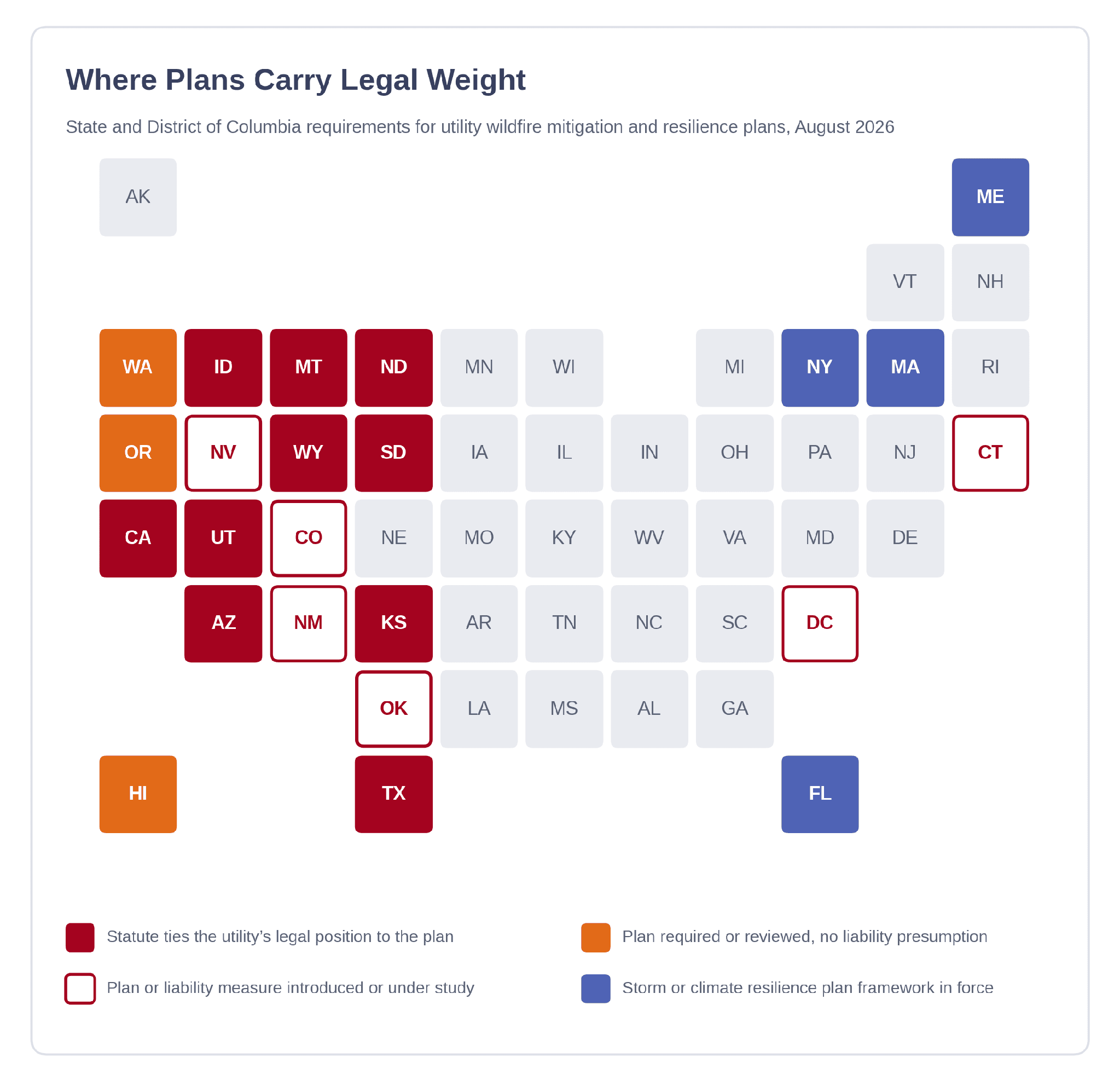
An updated wildfire-specific policy tracker is available through SEPA.
The plan cuts both ways
Utility lawyers have a blunt way of putting it: the most dangerous sentence in a wildfire mitigation plan is the one describing work that never happened. In states where the plan carries a liability presumption, it is the document a court will measure the utility against. A plan written to impress, listing every program the utility aspires to run at a pace it cannot staff or fund, converts ambition into exposure. The first test a plan has to pass is feasibility.
The most dangerous sentence in a wildfire mitigation plan is the one describing work that never happened.
Spending without evidence is the other failure mode. In April 2025, Utah’s commission cut more than $100 million of wildfire-related capital and insurance costs from a major utility’s rate case, while approving the smaller wildfire investments the record actually supported.5 The lesson for anyone drafting a plan: commitments the utility cannot perform get caught short after a fire, and spending that arrives without a quantified, jurisdiction-specific risk case gets second-guessed at cost recovery. The plans that hold up describe work the utility can actually perform, tie each commitment to measured risk, and keep a record of what was done.
What the statutes ask for
Put the new state requirements next to each other and the same elements repeat. Most of these ask the utility to know things and to decide things: where is the risk, when do conditions turn dangerous, what did you do about it, and can you show your work? Hardening belongs in every plan, but rebuilding line is measured in years and rate cases. The information and decision elements can be real within a single fire season, and they are what a reviewer tests first, because they reveal whether the rest of the plan rests on evidence or assertion.
What the new statutes repeat:
- Risk assessment: where ignition risk exists on the system and what a fire would cost
- Situational awareness: monitoring of weather and fire conditions
- Operational protocols: protection settings and de-energization for elevated risk, as a last resort
- Vegetation management and inspections
- Ignition tracking
- Regular reporting against the plan
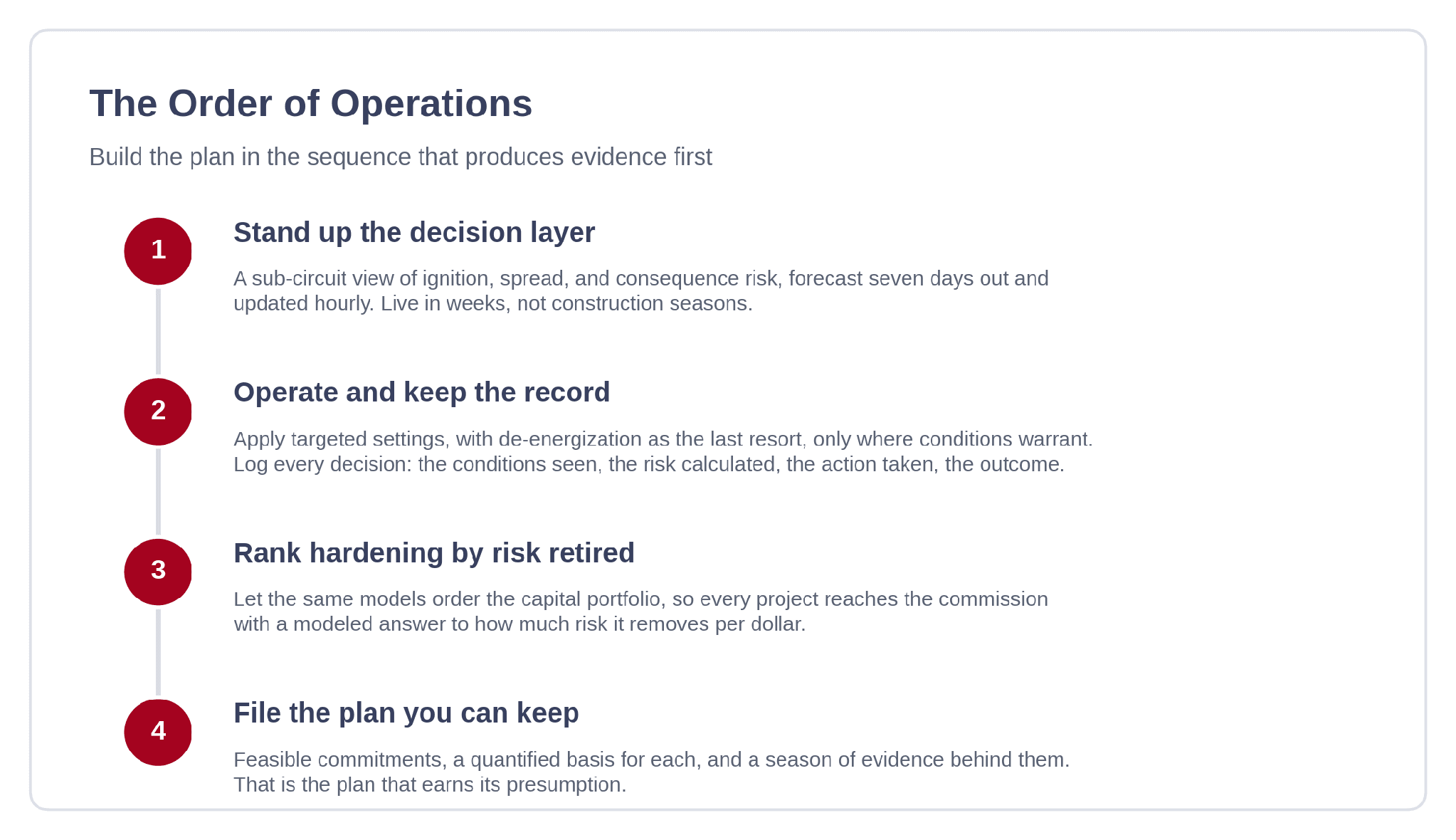
Stand up the decision layer first
That points to a specific sequencing choice: stand up situational awareness and forecast-driven operating decisions first. This one capability covers more of the statutory elements than anything else a utility can buy or build this year, costs a small fraction of what hardening costs, and starts producing evidence the first week it runs.
In practice, the utility has a forward view of ignition likelihood, fire spread potential, and consequence, resolved to the sub-circuit level, forecast several days out and updated as conditions change. When conditions warrant, operators apply the protective response that fits the risk at that location: faster trip settings, hot line tags, blocking reclosers, and, only as a last resort, de-energization. Each decision leaves a record — the conditions the model saw, the risk it calculated, the action taken, the outcome. Over a season, that record becomes the substance of the annual report and the utility’s answer to the question every reviewer eventually asks: how does your utility decide? It is also a commitment a small team can keep. It requires no new equipment on the grid and no multi-year construction program, which matters for the feasibility test above.
The evidence for operating decisions
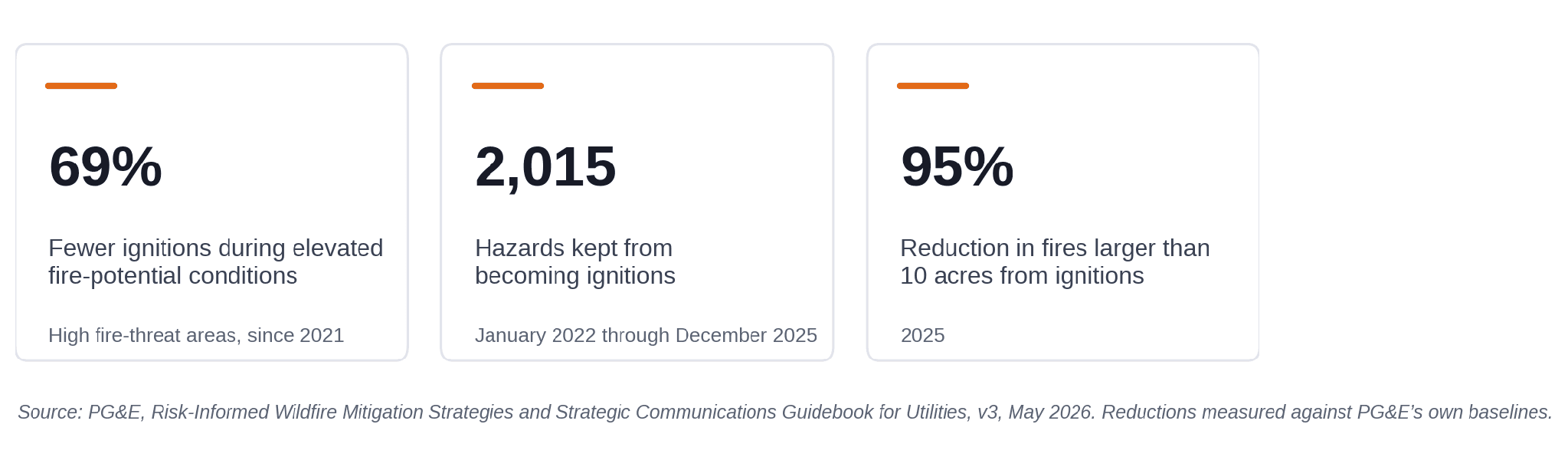
The strongest public results come from California. PG&E has run risk-informed protection settings across its high fire-threat areas since 2021, and through 2025 those settings, paired with downed-conductor detection, have sustained a 69 percent reduction in the ignition rate during elevated fire-potential conditions compared to the pre-program baseline, across roughly 44,000 powerline miles protecting 1.8 million customers.6 Those are one utility’s results, achieved with its own models, meteorologists, and control systems. The point is what the category can do: the largest documented ignition reductions in the industry right now come from operating decisions, not new construction, and the capability behind them is the one the statutes ask for — knowing where the risk is, hour by hour, at a resolution operators can act on.
The same evidence shows how unforgiving these tools are when applied at coarse resolution. When Xcel Energy made Colorado’s first preemptive shutoff in April 2024, cutting power to about 55,000 customers ahead of a windstorm, the state’s commission opened a formal investigation within days and sent the company’s next mitigation plan to a fully litigated review.7 Hawaiian Electric switched on a shutoff program covering roughly 47,000 customers in July 2024, and even a well-run shutoff carries a reliability bill, since lines must be inspected before re-energization.8
The heavier penalties have fallen on utilities that held off. An Oregon jury in 2023 found PacifiCorp grossly negligent for keeping lines energized through the 2020 Labor Day windstorm, and the company has paid more than $1.3 billion in settlements against $2.75 billion in accrued probable losses — exposure that persists even though an appellate court reversed the class verdict on procedural grounds in April 2026 and a state forestry report has since disputed the causation findings for one of the four fires.9 In Hawaii, where no shutoff program existed before the Lahaina fire, Hawaiian Electric’s share of the Maui settlement is $1.99 billion.10 Six years of litigation did not spare PacifiCorp the cost of defending decisions it could not document. A utility now answers to its commission when it shuts off too broadly and to juries when it does not act at all. The defensible path between those outcomes is when protection settings and de-energization decisions are made at fine granularity, using data-driven forecast conditions, with the reasoning recorded.
A utility now answers to its commission when it shuts off too broadly, and to juries when it does not act at all.
The order of operations
Hardening still belongs in every plan. A plan built decision-layer-first makes promises the utility can keep, backs them with quantified risk, and documents its own execution so that when the hardening capital request arrives, it arrives with the risk case regulators are now demanding.
If your team is drafting a first plan or updating one this cycle, we would like to hear how you are sequencing it, and we are glad to share what has worked for utilities facing similar windows.
Ready to Enhance Your Wildfire Risk Management?
Learn how Firescape can help your utility proactively manage wildfire risk and protect the communities you serve.
Get a DemoSources
- Alexandra Bruer and Katrina Groshong, "California Wildfires Heat Up Legal Risks for Electric Utilities," Bloomberg Law, Sept. 22, 2025. South Dakota S.B. 36 (signed Mar. 12, 2026): Seth Tupper, "New Law Limiting Utilities’ Liability Approved as Wildfires Break Out in Black Hills," South Dakota Searchlight, Mar. 12, 2026. Kansas H.B. 2107 (2025): "The Fires Next Time: State Wildfire Liability Limitations for Utilities," McDermott Will & Emery, May 19, 2026.
- Washington E.S.H.B. 1522 (2025), House Bill Report, Washington State Legislature.
- NARUC, Wildfire Workbook: Information for Utility Regulators, launched November 2025 and completed with chapters 4–7 in January 2026.
- Insurers Say Arizona’s Wildfire Mitigation Plans Are Not Enough, KNAU/Arizona Public Radio, Mar. 19, 2026.
- Utah Public Service Commission, Order, Docket Nos. 24-035-04, 23-035-40 & 23-035-44, Apr. 25, 2025. See also Amy Joi O’Donoghue, "Rocky Mountain Power Ready to Put the Gloves on in Rate Case Fight," Deseret News, July 11, 2025.
- Pacific Gas and Electric Company, 2025 Wildfire Mitigation Plan Annual Implementation Report. Customer and mileage figures: PG&E Corporation, Notice of Annual Meeting and Proxy Statement (Form DEF 14A), Mar. 2025.
- Colorado Public Utilities Commission, PUC Response to April 2024 Wildfire Power Shut-Offs (Proceeding 24M-0173E). "Colorado PUC Adopts Interim Recommendations to Increase Consumer Protections During Weather Events," Colorado PUC press release, Oct. 10, 2024.
- Hawaiian Electric, Public Safety Power Shutoff program fact sheet, effective July 1, 2024.
- Pat Dooris, "Oregon Appeals Court Reverses Ruling That Found PacifiCorp Liable in Deadly 2020 Labor Day Wildfires," KGW News, Apr. 8, 2026. Kaylee Tornay, "New Oregon Department of Forestry Report Says PacifiCorp Wasn’t Responsible for Santiam Canyon Fire," Willamette Week, Mar. 19, 2025.
- Munger, Tolles & Olson LLP, Munger, Tolles & Olson Negotiates Historic Maui Wildfire Settlement, Nov. 7, 2025.